
The process of being able to calculate the CO₂ footprint of pork at the push of a button isn’t complete yet. Thanks to craftsmanship and efficiency, it’s already low—especially compared to neighboring countries. Finn de Bruijn observes that the supply chain is motivated to reduce it even further. “In five years, it will be unthinkable for a Dutch pig farmer not to manage based on CO₂ footprint,” he says.
Helping the Sector Move Forward
As part of a twenty-week internship during his third year at HAS Green Academy in Venlo, Finn de Bruijn joined aaff, an accountancy and consultancy firm. Together with senior business adviser Frank Steenbreker, he worked on a project in close collaboration with the Dutch Pig Farmers’ Organization (POV) and the Coalition for a Vital Pig Sector (CoViVa).
Their goal: to help the sector advance in developing a process that enables fast, reliable, and standardized calculation of CO₂ footprints on pig farms. In addition, they wanted to give farmers insight into which levers they can pull to steer their farm’s emissions in the desired direction.
From February to July, De Bruijn visited 35 pig farmers to fill out the CO₂ Footprint Tool in MijnPOV for their businesses. “You quickly see that figures such as the number of pigs delivered or purchased and the tons of feed can be collected at the push of a button,” he notes.
Daily Manure Removal and Processing Cut the Footprint by Almost 20%
Finn de Bruin, stuent at HAS Green Academy: “When you go deeper into details—like the nutrient composition of feed, which farmers need to obtain from their feed suppliers, or aspects of manure and energy use on the farm—there are still improvements to be made,” he continues.
A Changing Mindset
“Working on the CO₂ footprint of their farms has started to change the mindset of pig farmers and other chain partners,” De Bruijn observes. “Awareness of the importance of addressing this is growing.”
The student focused primarily on the on-farm phase, while POV policy officer Wilfried Goldewijk worked on the feed-industry side. The main contributors to the pork carbon footprint are feed (60–65%) and housing and manure storage (25–30%). Animals account for 5–10%, energy for 1–5%, and transport, slaughter, and processing for 3–5%.
Despite the participants’ motivation, De Bruijn found data collection and processing highly labor-intensive. “Finding detailed information—such as RAV codes, energy types and usage, solar-power generation, and energy suppliers—is a puzzle. Not everything fits neatly into standardized categories.”
“For instance, how do you account for emissions from slurry in shallow pits that are emptied frequently, while the standard assumes six months of storage?” he asks during his final discussion with Steenbreker, POV chair Linda Verriet, and Jan van Haperen, head of nutrition at Fransen Gerrits. “Every pig farm is different, and the calculation rules—especially regarding manure—still need fine-tuning.”
Promising Early Results
Although his internship focused on improving the calculation process rather than producing exact results, De Bruijn ran some preliminary analyses. These showed that breeding farms storing manure for six months under the slatted floor could achieve nearly 20% lower CO₂ footprint per piglet if they switched to daily manure removal and processing.
Sharing Data: A Sensitive Issue
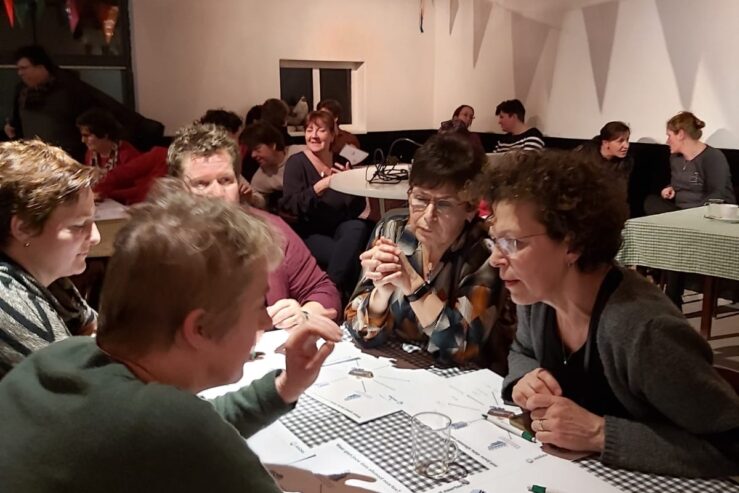
His findings sparked a lively discussion with Steenbreker, Verriet, and Van Haperen. Pig farmers, it turns out, are often reluctant to share farm data with supply-chain partners. “They fear being judged or penalized based on their CO₂ footprint if they share it too early,” De Bruijn notes.
All agreed on the importance of a trusted intermediary such as JoinData, which can securely transmit data on behalf of farmers only to partners they themselves authorize.
“We can already help pig farmers organize their feed data properly,” says Van Haperen. “The correct ingredient data are in our system, and our IT is ready for it.”
According to De Bruijn, providing accurate data remains a major challenge for many feed suppliers. “But I do see that the CO₂ footprint is becoming a serious topic across the chain. If slaughterhouses rewarded pig farmers who know their footprint with even one cent more per kilo, that would give the whole process a real boost and greatly accelerate data sharing.”
Valuable Experience
Steenbreker concludes that De Bruijn delivered excellent work—work the pig sector can build on.
De Bruijn adds: “I’m glad I’ve been able to look inside so many different organizations and expand my network along the way.”